
How to Choose the Right Water Filter Supplier
Choosing the Right Water Filter Supplier: A Guide to Ensuring Quality and Trust
Access to clean, safe, and great-tasting water is not just a luxury—it’s a necessity. Whether you’re running a business that requires high-volume filtration or you’re a homeowner looking to upgrade your kitchen setup, the quality of your water depends entirely on the equipment you choose.
But with thousands of brands and distributors on the market, how do you decide who to trust? Choosing a water filter supplier is about more than just picking a price tag; it’s about finding a long-term partner who prioritizes your health and operational efficiency.
Here is a step-by-step guide on how to choose the right water filter supplier for your needs.
1. Check for Certifications and Standards
The water filtration industry is heavily regulated for good reason. Before considering a supplier, verify that their products meet international safety standards.
Look for certifications from reputable third-party organizations such as:
- NSF International: The gold standard for water quality testing. Check if the filters are certified to NSF/ANSI standards for contaminants like lead, chlorine, or cysts.
- WQA (Water Quality Association): A Gold Seal designation from the WQA is a strong indicator of product reliability.
If a supplier cannot provide documentation or proof of these certifications, look elsewhere. Your health shouldn't be a gamble.
2. Assess Their Expertise and Consultation
A good supplier shouldn’t just move boxes; they should be consultants. Every water source is different—some have high mineral content (hard water), while others may have high sediment or chemical levels.
The right supplier will:
- Ask for a water quality report: They shouldn't sell you a "one-size-fits-all" filter without understanding your specific water profile.
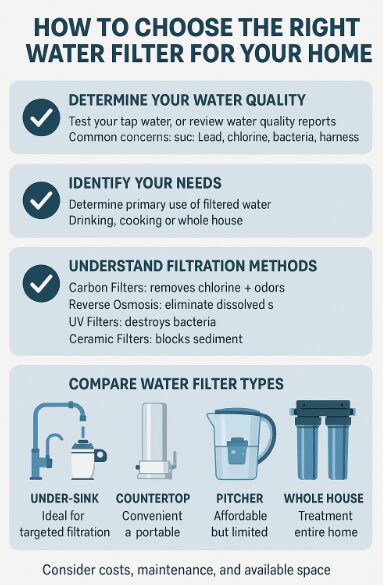
- Explain the technology: Whether it’s Reverse Osmosis (RO), Activated Carbon, or UV purification, they should be able to explain why a specific technology is right for your unique situation.
3. Evaluate Long-Term Maintenance and Support
A water filter is only as good as its replacement schedule. A common pitfall for buyers is purchasing a system from a supplier who stops stocking the specific replacement cartridges a year later.
Before you buy, ask the following:
- Are replacement parts readily available? Can you easily order filters online, or do you have to go through a complicated proprietary process?
- Is there technical support? If you have a leak or a pressure drop, is there a customer service team that knows how to troubleshoot the system?
- What is the warranty policy? A reputable company stands behind its hardware with clear warranty terms.
4. Look for Transparency in Performance Data
Marketing terms like "Pure Water" are vague. A professional supplier will provide specific data sheets.
Look for information regarding:
- Micron rating: How small of a particle does the filter catch?
- Flow rate: Will the filter slow down your water pressure to an annoying crawl?
- Contaminant reduction percentage: They should be able to tell you exactly how much of a specific contaminant (e.g., 99% of chlorine) the filter removes.
5. Research Reputation and Reviews
In the digital age, a company’s reputation is easy to verify. Beyond the company's own website, check:
- Google Reviews and Trustpilot: Look for recurring complaints about shipping delays, faulty components, or poor customer service.
- Industry Longevity: A company that has been in business for a decade is likely more stable than a "pop-up" shop selling generic rebranded filters from an unknown factory.
6. Consider the Total Cost of Ownership (TCO)
The price of the initial unit is only part of the equation. When comparing suppliers, calculate the Total Cost of Ownership.
Some systems are cheap to install but require expensive, proprietary filters every three months. Others may have a higher upfront cost but use cost-effective, long-lasting filter cartridges. Ask for the expected annual maintenance cost before you sign off on the purchase.