
What Criteria Should I Use to Filter Suppliers?
What Criteria Should I Use to Filter Suppliers?
Introduction
In today’s hyper‑connected market, the “right” supplier can be the difference between a product that flies off the shelves and one that gathers dust. Yet the process of selecting a supplier isn’t just about finding the lowest price or the fastest delivery window. It’s a strategic decision that impacts quality, risk, brand reputation, sustainability, and ultimately, your bottom line.
If you’ve ever felt overwhelmed by the sea of potential partners, you’re not alone. Below is a practical, step‑by‑step framework that lets you filter suppliers with confidence—whether you’re a startup building its first vendor network or a multinational looking to tighten an existing portfolio.
Pro tip: Treat supplier selection as an ongoing “qualification” process, not a one‑off checkbox. Your criteria should evolve as market conditions, regulations, and your own business goals change.
1. Define Your Business Objectives First
Before you even open a spreadsheet, ask yourself:
| Question | Why It Matters |
|---|---|
| What are our core value propositions (cost leadership, speed, quality, sustainability)? | Aligns supplier attributes with what you promise customers. |
| Which markets or customers are we targeting? | Influences location, compliance, and language capabilities. |
| What is our risk tolerance? | Determines how much financial, geopolitical, or operational risk you can absorb. |
| Do we have a corporate ESG (Environmental, Social, Governance) mandate? | Shapes sustainability and ethical sourcing criteria. |
Answering these questions provides a “north star” that will guide every subsequent filter.
2. Core Evaluation Categories
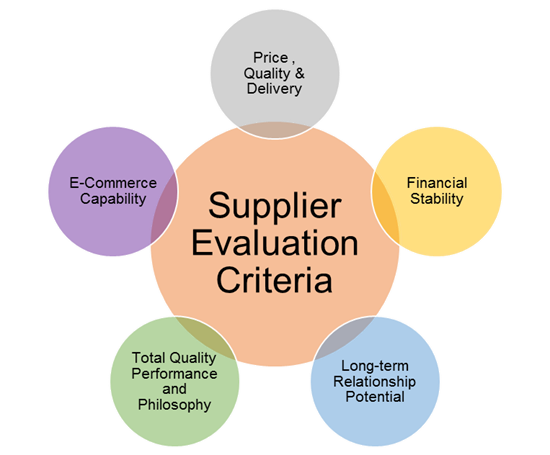
Below are the eight most critical pillars to assess when filtering suppliers. Each pillar contains concrete sub‑criteria you can score or weight.
2.1 Financial Health & Stability
| Sub‑criteria | How to Verify |
|---|---|
| Revenue & profit trends (last 3‑5 years) | Annual reports, credit bureau, Dun & Bradstreet. |
| Liquidity ratios (current ratio, cash‑to‑debt) | Financial statements or third‑party credit reports. |
| Credit rating | Moody’s, S&P, or local equivalents. |
| Bank references | Direct request for confirmation of account standing. |
Why it matters: A supplier in financial distress can default, delay deliveries, or cut corners on quality.
2.2 Quality & Compliance
| Sub‑criteria | How to Verify |
|---|---|
| ISO certifications (9001, 14001, 45001, etc.) | Certificate copies, audit reports. |
| Product conformity (RoHS, REACH, FDA, CE) | Test reports, third‑party lab results. |
| Historical defect rate (PPM – parts per million) | Supplier scorecards; internal QC data. |
| Traceability (lot numbers, batch records) | Review of ERP or MES data. |
Why it matters: Consistent quality protects brand reputation and reduces rework costs.
2.3 Capacity & Lead‑time Flexibility
| Sub‑criteria | How to Verify |
|---|---|
| Maximum output (units/month, tons/year) | Capacity tours, production schedules. |
| Utilization rate (current vs. max) | Operational KPIs from the vendor. |
| Scalability (ability to ramp up quickly) | Case studies, past surge performance. |
| Lead‑time variability (average +/- SD) | Historical order data. |
Why it matters: A low‑cost partner that can’t meet demand spikes is a hidden cost.
2.4 Cost Structure & Pricing Transparency
| Sub‑criteria | How to Verify |
|---|---|
| Unit price & volume discounts | Formal quotation, price list. |
| Total Cost of Ownership (TCO) (shipping, duties, handling) | Cost breakdown spreadsheet. |
| Currency risk exposure | Contract terms (e.g., FOB vs. CIF, hedging clauses). |
| Cost‑increase triggers (raw‑material indexation) | Contractual clauses. |
Why it matters: Hidden fees can erode the apparent price advantage.
2.5 Sustainability & ESG Performance
| Sub‑criteria | How to Verify |
|---|---|
| Carbon footprint (Scope 1‑3 emissions) | GHG inventory reports, CDP disclosures. |
| Resource usage (water, energy) | Sustainability audit, certifications (ISO 14001). |
| Labor standards (fair wages, child‑labour policies) | Third‑party audit (Sedex, BSCI). |
| Circularity (recyclability, waste reduction) | Product design documentation, end‑of‑life plans. |
Why it matters: Consumers and investors increasingly demand responsible sourcing.
2.6 Risk & Resilience
| Sub‑criteria | How to Verify |
|---|---|
| Geopolitical risk (country stability, trade sanctions) | World Bank, Bloomberg risk indices. |
| Supply‑chain redundancy (dual‑source options) | Mapping of alternative suppliers. |
| Business continuity plans | Review of BCP documents, emergency drills. |
| Insurance coverage (product liability, cargo) | Certificates of insurance. |
Why it matters: A resilient supplier can keep you running when the unexpected hits.
2.7 Technological Compatibility
| Sub‑criteria | How to Verify |
|---|---|
| Digital integration (EDI, API, blockchain) | System demos, integration roadmaps. |
| Data accuracy & real‑time visibility | Sample data feeds, dashboard screenshots. |
| Innovation pipeline (R&D capabilities) | Patent portfolio, joint‑development agreements. |
| Cybersecurity posture (ISO 27001, SOC 2) | Security audit reports. |
Why it matters: Seamless data exchange shortens order‑to‑cash cycles and reduces errors.
2.8 Relationship & Communication
| Sub‑criteria | How to Verify |
|---|---|
| Responsiveness (average reply time) | Test with a series of queries. |
| Cultural fit (language, business etiquette) | Interviews, site visits. |
| Contractual flexibility (change‑order handling) | Review of master service agreement. |
| References (existing client testimonials) | Direct calls with current customers. |
Why it matters: A partner who “gets” you will be easier to manage long‑term.
3. Scoring & Weighting – Turning Criteria into a Decision Model
- Create a scoring matrix (e.g., Excel, Power BI, or a dedicated SRM tool).
- Assign weights based on strategic priority. Example:
| Pillar | Weight % |
|---|---|
| Financial Health | 15 |
| Quality & Compliance | 25 |
| Capacity & Flexibility | 15 |
| Cost Structure | 10 |
| Sustainability | 10 |
| Risk & Resilience | 15 |
| Technology | 5 |
| Relationship | 5 |
(Adjust percentages to match your own strategic focus.)
- Rate each supplier on a 1‑5 scale (1 = Poor, 5 = Excellent) for every sub‑criterion.
- Calculate a weighted score:
Σ (criterion rating × weight). - Set a threshold (e.g., 3.8/5) and filter out those below it.
Tip: Use colour‑coding (green/red) to flag “go”, “caution”, and “no‑go” suppliers instantly.
4. Tools & Technologies to Simplify Supplier Filtering
| Tool | Primary Function | Why It Helps |
|---|---|---|
| SAP Ariba / Coupa | Cloud‑based SRM, spend analysis, e‑procurement | Centralised data, automated scoring templates |
| Jaggaer | Supplier risk management & ESG tracking | Built‑in risk scorecards, sustainability modules |
| GEP SMART | End‑to‑end sourcing, AI‑driven supplier recommendation | Predictive analytics for cost & risk |
| Dun & Bradstreet D‑University | Credit risk, financial health dashboards | Real‑time financial alerts |
| EcoVadis | ESG ratings, sustainability scorecards | Pre‑validated ESG data across millions of suppliers |
| Microsoft Power BI | Custom visualisation of supplier metrics | Quick dashboards for exec‑level reporting |
No matter the platform, the key is to capture data consistently and keep it up‑to‑date.
5. The Human Element – Conducting Supplier Audits & Site Visits
Even the most sophisticated software can’t replace a good old‑fashioned audit. Here’s a quick agenda for a one‑day supplier audit:
| Time | Activity |
|---|---|
| 08:30 – 09:00 | Opening meeting – objectives & agenda |
| 09:00 – 10:30 | Facility tour – production lines, storage, QC labs |
| 10:30 – 11:15 | Document review – certifications, financials |
| 11:15 – 12:00 | Interviews – plant manager, quality lead |
| 12:00 – 13:00 | Lunch (informal relationship building) |
| 13:00 – 14:30 | Spot‑check of a random batch – test for conformance |
| 14:30 – 15:30 | Review of sustainability data – waste, energy |
| 15:30 – 16:30 | Wrap‑up – findings, next steps, Q&A |
| 16:30 – 17:00 | Exit meeting – agree on corrective actions (if any) |
Takeaway: Document everything, assign responsibility for follow‑up actions, and set a timeline for remediation.
6. Continuous Monitoring – From On‑Boarding to Ongoing Qualification
| Phase | Action | Frequency |
|---|---|---|
| On‑boarding | Complete initial scoring, sign contracts, set up data exchange | One‑time |
| Quarterly | Review performance dashboards (quality, on‑time delivery, cost variance) | 4×/yr |
| Bi‑annual | Re‑assess financial health and ESG ratings | 2×/yr |
| Ad‑hoc | Triggered by major events (e.g., raw‑material price shock, geopolitical change) | As needed |
| Annual | Full supplier audit (financial, compliance, sustainability) | 1×/yr |
A Supplier Relationship Management (SRM) portal can automate many of these touch‑points, sending alerts when a KPI drifts outside acceptable bounds.
7. Real‑World Example: How a Mid‑Size Electronics OEM Cut Costs by 12%
| Step | What They Did | Result |
|---|---|---|
| Define criteria | Prioritised Quality (30%), Cost (25%), ESG (20%), Risk (15%), Capacity (10%) | Clear decision framework |
| Score 30 candidates | Used an Excel matrix, weighted scoring | 12 “green”, 8 “yellow”, 10 “red” |
| Deep‑dive audit | On‑site visits to the “yellow” group, focused on capacity | Identified 3 suppliers with hidden overtime costs |
| Renegotiated contracts | Consolidated volume to top 5 suppliers, introduced a volume‑rebate clause | 8% price reduction |
| Implemented ESG monitoring | Adopted EcoVadis for quarterly sustainability scores | 4% additional cost savings via waste‑reduction initiatives |
| Result | Total cost of goods sold (COGS) fell 12%; on‑time delivery improved from 92% to 98% | Stronger brand perception; lower risk exposure |
8. Common Pitfalls & How to Avoid Them
| Pitfall | Symptom | Prevention |
|---|---|---|
| Over‑emphasis on price | Frequent price renegotiations, quality issues | Set a minimum quality score before price is considered. |
| One‑time qualification | Supplier performance drifts silently | Build a continuous monitoring loop. |
| Ignoring cultural fit | Miscommunication, delayed approvals | Include “relationship” criteria and run soft‑skill interviews. |
| Neglecting ESG | Reputation damage, loss of eco‑conscious customers | Make sustainability a weighted pillar, not an after‑thought. |
| Relying on self‑reported data | Inaccurate financial or compliance claims | Use third‑party verification (credit bureaus, certification bodies). |
| Not planning for disruption | Supply shortages during pandemics, geopolitical events | Map multiple sources, maintain safety stock, evaluate risk scores. |
9. Quick Checklist – 20‑Item Supplier Filter Cheat Sheet
| # | Criterion | Yes/No |
|---|---|---|
| 1 | Current financial statements (last 3 years) | |
| 2 | Credit rating ≥ B‑ | |
| 3 | ISO 9001 certification | |
| 4 | Product compliance (RoHS, REACH, etc.) | |
| 5 | Historical defect rate < 500 PPM | |
| 6 | Capacity ≥ 1.5× your forecasted demand | |
| 7 | Lead‑time variance ≤ ±10% | |
| 8 | Unit price within target range | |
| 9 | Transparent cost breakdown (TCO) | |
| 10 | Scope 1‑3 emissions disclosed | |
| 11 | ESG score on EcoVadis ≥ 70 | |
| 12 | No active sanctions or trade restrictions | |
| 13 | Dual‑source capability for critical parts | |
| 14 | Business continuity plan documented | |
| 15 | API/EDI integration capability | |
| 16 | ISO 27001 or equivalent cybersecurity | |
| 17 | R&D pipeline aligned with your roadmap | |
| 18 | Average email response < 4 hours | |
| 19 | Favorable cultural/ language match | |
| 20 | References from at least 2 existing clients |
If a supplier fails more than 3 items, consider them a “no‑go” unless you have a compelling mitigation plan.
10. Final Thoughts
Filtering suppliers isn’t a static “check‑the‑box” exercise—it’s a dynamic, strategic discipline. By aligning financial stability, quality, capacity, cost, sustainability, risk, technology, and relationship criteria with your business goals, you create a resilient supply chain that can thrive amid price volatility, regulatory shifts, and evolving consumer expectations.
Remember:
- Weight your criteria to reflect true strategic priorities.
- Score objectively and keep the process transparent for internal stakeholders.
- Audit and monitor continuously, because the market—and your suppliers—never stand still.
When you treat supplier selection as a living, data‑driven process, you not only protect your bottom line—you also unlock opportunities for innovation, brand differentiation, and long‑term growth.
Happy sourcing! 🚀